

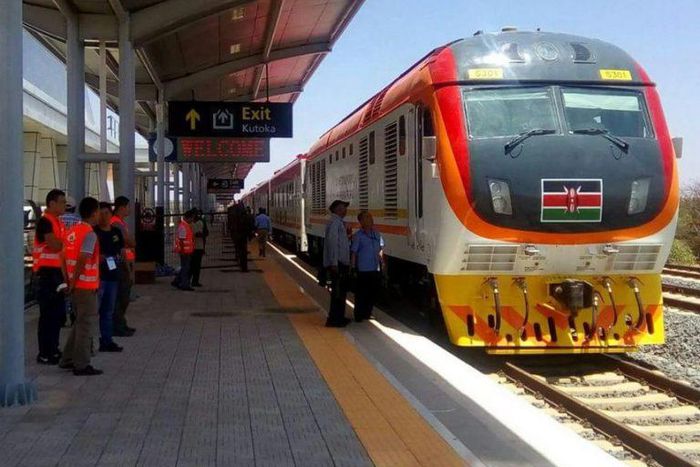
Somewhere between Mtito Andei and Voi, the train slows to a crawl and a herd of red-dusted elephants appears through the window. Not behind a fence. Not in a zoo. Just there, walking parallel to the track through Tsavo, the same landscape they have crossed for centuries, now bisected by a Chinese-built railway that moves 30,000 passengers a day. The woman across the aisle puts down her phone. The kid behind you stands on his seat. Nobody says a word. This is the free safari that comes with a KES 1,500 train ticket.
The Madaraka Express, Kenya’s Standard Gauge Railway, replaced the colonial-era “Lunatic Express” in 2017 and turned a 15-hour overnight ordeal into a five-hour air-conditioned ride between the country’s two largest cities. It is now one of the most practical, affordable, and genuinely enjoyable ways to travel in East Africa.
The Route
Nairobi Terminus (Syokimau) to Mombasa Terminus (Miritini). The full distance is 472 km. The train passes through Athi River, Emali, Kibwezi, Mtito Andei, Voi, Miasenyi, and Mariakani before arriving at the coast. The route cuts directly through Tsavo East and Tsavo West National Parks, which is where the wildlife sightings happen.
Both termini are outside the city centres. This is the single most important logistical detail that first-time riders miss.
Three Daily Departures
The Madaraka Express runs three trains daily in each direction:
8:00 AM Inter-County Service: stops at all stations along the route. Arrives roughly six hours later around 2:00 PM. This is the slower option but useful if you are getting off at an intermediate stop like Voi (gateway to Tsavo).
3:00 PM Express Service: the most popular departure. Stops only at Voi. Arrives approximately 8:00 PM. This is the train most tourists take.
10:00 PM Night Express: no stops or limited stops. Arrives approximately 3:30 AM. Fastest option but you arrive in the middle of the night. Best for budget travelers who want to save on accommodation for one night, or anyone connecting to an early morning departure from Mombasa.
The same schedule runs in reverse from Mombasa to Nairobi.
Ticket Prices
Fares are fixed by Kenya Railways and do not change with seasons or demand. As of 2025/2026:
Economy Class (Nairobi to Mombasa): KES 1,500 per adult one way. First Class (Nairobi to Mombasa): KES 4,500 per adult one way.
Children aged 3 to 11: half fare in both classes. Under 3: free but no allocated seat. Over 11: full adult fare.
The fare is the same whether you take the express or inter-county service. Luggage allowance: up to 30 kg, not exceeding 1.6 metres in any dimension.
For context, a one-way economy flight from Nairobi to Mombasa on Jambojet or Kenya Airways starts from roughly KES 4,000 to KES 8,000 depending on booking time. The SGR economy ticket is a fraction of the cost.
How to Book
Three options:
Online: Go to metickets.krc.co.ke. Select your date, time, class, and number of passengers. Pay via M-Pesa. You receive a ticket confirmation via email or SMS with your coach and seat number. You cannot choose specific seats.
USSD (mobile): Dial *639# on a Safaricom line and follow the prompts. Same process, no internet needed. Payment via M-Pesa.
Station counter: Walk up to the ticket counter at either Nairobi Terminus or Mombasa Terminus. Cash and card accepted. This is the fallback option if online booking fails or if you need to travel same-day.
Book in advance. Tickets sell out during weekends, public holidays, school holidays, and the December festive season. Kenya Railways added extra trains during December 2025 to January 2026 to handle demand. During peak periods, book at least one to two weeks ahead. Midweek tickets are almost always available on short notice.
Ticket cancellation incurs a 30 percent penalty fee. Rescheduling incurs a 10 percent penalty. Book only when your dates are confirmed.
Getting to and from the Termini
This is where the trip requires planning.
Nairobi Terminus is in Syokimau, roughly 20 km southeast of the CBD. Options: take the commuter train from Nairobi CBD railway station at 6:10 AM (KES 50), use the shuttle bus service from the CBD station, or take an Uber/Bolt (approximately KES 500 to KES 1,000 depending on traffic and time of day). For the 3:00 PM express, leave central Nairobi by 1:00 PM at the latest. Nairobi traffic between 12:00 and 2:00 PM on the route to Syokimau is unpredictable.
Mombasa Terminus is in Miritini, roughly 15 km west of Mombasa CBD. Kenya Railways operates a bus service between the old Mombasa railway station on Mijikenda Road and the Miritini Terminus for KES 100. Alternatively, Uber/Bolt from Mombasa CBD to Miritini runs approximately KES 400 to KES 800.
If you are heading to Diani Beach from Mombasa Terminus, you still need to get through Mombasa city and across the Likoni Ferry. Total time from Miritini to Diani: one to two hours depending on ferry wait times. Pre-arrange a taxi through your Diani hotel or use Uber. The ferry is free for pedestrians.
What the Classes Are Actually Like
Economy Class: standard airline-style seating in rows of three on each side. Seats recline slightly. Air-conditioned. Clean. Adequate legroom for most body types but not generous. Large windows. Power outlets between seats (bring your own cable). No assigned meal service but a food trolley passes through. The atmosphere is lively, this is how most Kenyans travel the route and the energy reflects it.
First Class: wider seats in a 2+2 configuration. More legroom. Quieter. A complimentary snack and drink are sometimes included. The main practical advantage over economy is the extra space and the reduced noise level. Both classes have the same views and the same arrival time.
There is no sleeper service. All seats are upright. The night train is the same seating as the day trains.
The Tsavo Wildlife Window
The train passes through Tsavo on an elevated track with wildlife underpasses built beneath the rails. The best viewing window is roughly 1.5 to 2 hours into the journey from Nairobi (or 2 to 3 hours from Mombasa). Elephants are the most commonly spotted animals, often Tsavo’s distinctive red-soiled herds. Giraffes, zebras, gazelles, and impalas are also regularly visible. Occasional sightings of larger predators have been reported but are rare from the train.
Sit on the left side of the train (heading toward Mombasa) for the best views through Tsavo. The windows are large enough for photography but the glass has a slight tint. Reflections from interior lighting on the night train make wildlife spotting from the 10:00 PM departure impossible.
Food and Drink
A trolley service sells snacks, drinks, and basic meals (samosas, sandwiches, water, soda, tea). Prices are reasonable. Do not expect a dining car experience. Most regular travelers bring their own food and drinks for the journey. There is no alcohol sold onboard.
Pack water, snacks, and a phone charger. Five hours is comfortable but not short.
Security
Security at both termini is extensive. You pass through multiple checkpoints with bag screening and ID verification before reaching the platform. You will need your national ID or passport, matching the name on your ticket. Arrive at least 45 minutes before departure to clear security. During peak periods, an hour is safer.
Onboard, security personnel are present throughout the journey. The train is considered safe. Petty theft is extremely rare compared to road transport.
Compared to Driving
The Nairobi-Mombasa highway (A109) is roughly 490 km and takes six to eight hours by road depending on traffic, truck congestion through Mtito Andei, and the condition of the road surface. The highway has one of the highest accident rates in Kenya. Long-haul buses are cheap (KES 800 to KES 1,500) but significantly less comfortable and less safe than the train. Self-driving is feasible but tiring, particularly at night.
The SGR is faster, safer, more comfortable, and more reliable than road transport for this route. The only advantage of driving is the flexibility to stop wherever you want.
Compared to Flying
Flights from Nairobi (JKIA or Wilson) to Mombasa (Moi International) take roughly one hour. Fares range from KES 4,000 to KES 10,000 one way. Add airport transit time, check-in, and security, and the total journey from Nairobi CBD to Mombasa CBD is roughly three to four hours door to door.
The SGR takes roughly six hours door to door including terminal transfers. You save KES 2,500 to KES 8,500 compared to flying. You lose two to three hours. And you see elephants through the window. For most travelers, particularly those heading to the south coast (Diani), the time difference is less significant than it appears because the Likoni Ferry bottleneck affects both routes equally.
Practical Tips
Book the 3:00 PM express for the best combination of daylight views and reasonable arrival time. Sit on the left (Nairobi to Mombasa) or right (Mombasa to Nairobi) for Tsavo views. Bring your own food, water, and a power bank. Arrive at the terminus at least 45 minutes early, an hour during holidays. Download offline entertainment, phone signal drops through parts of Tsavo. Book your onward transport from Mombasa Terminus before you board, do not arrive at Miritini at 8:00 PM without a plan.
Who This Is For
Budget travelers: the KES 1,500 economy fare is the best value intercity transport in Kenya. Families: safe, spacious enough for children, no seatbelt stress. First-time visitors: the Tsavo wildlife sighting from the train is a genuine bonus that no flight offers. Anyone heading to the coast: combining the SGR with a pre-booked Diani transfer is the smartest budget move for a safari-and-beach itinerary.
The SGR transported 2.39 million passengers between Nairobi and Mombasa in 2022 according to Kenya Railways data. That number has only grown. The train is not a tourist novelty. It is the backbone of Kenya’s intercity passenger network, used daily by Kenyans commuting, visiting family, and traveling for business. Riding it puts you inside the country in a way that a domestic flight never does.