

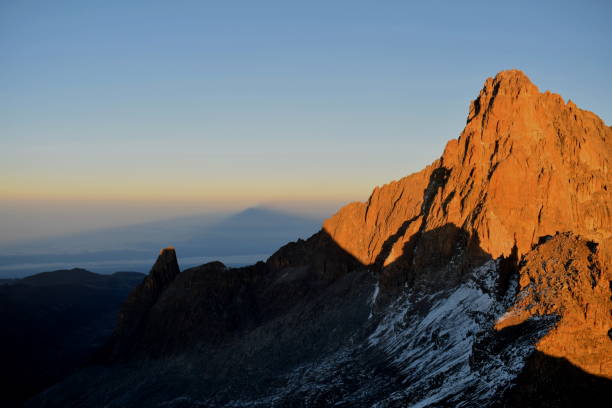
At 4,900 metres on the Chogoria route, the air is thin enough to make your breathing audible. The trail cuts through a valley of giant groundsel and lobelia, Afroalpine plants that look like something from a planet with different rules. Above you, the jagged peaks of Batian and Nelion catch the first light. Below, a glacial tarn reflects a sky that is still half dark. There is nobody else here. Not a single other climber on the trail. That last detail is the one that separates Mount Kenya from Kilimanjaro more than any statistic about altitude or difficulty ever could.
Kilimanjaro draws over 35,000 climbers annually. It is the highest mountain in Africa, the tallest free-standing mountain on earth, and one of the most recognizable summits in the world. It deserves its reputation. But reputation has consequences. The popular routes, Machame and Marangu in particular, can feel less like wilderness and more like a slow-moving queue at altitude, complete with porters carrying dining tables and tourists in matching team shirts.
Mount Kenya, 700 metres shorter and a three-hour drive from Nairobi, offers a fundamentally different experience. It is quieter, cheaper, more ecologically diverse, and, depending on which summit you aim for, either easier or dramatically harder than Kilimanjaro. Here is the case for choosing it.
The Numbers
Kilimanjaro: 5,895 metres (Uhuru Peak). Non-technical. Five to nine days. USD 2,000 to USD 6,000 depending on route, operator, and comfort level. Summit success rate roughly 65 to 70 percent, limited primarily by altitude sickness.
Mount Kenya, Point Lenana: 4,985 metres. Non-technical trek. Three to five days. USD 650 to USD 2,000 depending on route and operator. Higher success rate than Kilimanjaro due to lower altitude and better acclimatization profiles on most routes. Acute mountain sickness affects roughly 25 percent of Point Lenana trekkers compared to an estimated 77 percent on Kilimanjaro.
Mount Kenya, Batian: 5,199 metres. Technical rock and ice climb. Requires ropes, gear, and experienced mountaineering skills. This is a different proposition entirely and not comparable to Kilimanjaro’s trekking routes.
The Cost Difference
This is where the argument gets hard to ignore.
Kilimanjaro’s park fees alone are substantial. The Tanzanian National Parks Authority (TANAPA) charges fees that, combined with mandatory guide, cook, and porter costs, push even basic group climbs above USD 2,000 per person. Premium routes with longer acclimatization profiles (Lemosho, Northern Circuit) routinely exceed USD 4,000.
Mount Kenya treks to Point Lenana start from USD 650 to USD 800 with Kenyan operators for a four-to-five-day group climb. Private guided treks with higher comfort levels run USD 1,200 to USD 2,000. KWS park fees are lower than TANAPA fees. Porters and guides are required on most routes but team sizes are smaller than Kilimanjaro’s. The mountain is accessible from Nairobi by road in three to four hours, eliminating the need for a domestic flight to Moshi or Arusha.
For a traveler with a fixed budget, Mount Kenya delivers a comparable high-altitude trekking experience at roughly half the cost.
The Routes
Mount Kenya has three main trekking routes to Point Lenana:
Naro Moru Route: The shortest and most direct. Starts from the Naro Moru gate on the western side. Passes through the Meteorological Station (3,050 m, reachable by vehicle though hiking is recommended for acclimatization), then through the infamous “Vertical Bog,” a steep, often muddy section of moorland that tests patience more than fitness. Reaches Mackinder’s Camp (4,200 m) before the pre-dawn summit push. Duration: three to four days. This is the route most budget operators use. It is efficient but not the most scenic.
Sirimon Route: Starts from the northern side. The gentlest gradient of the three routes and the best for acclimatization. Passes through bamboo forest, then open moorland with views of Terere and Sendeo peaks. Camps at Old Moses Hut (3,300 m) and Shipton’s Camp (4,200 m). Duration: four to five days. Recommended for first-time high-altitude trekkers who want a measured ascent.
Chogoria Route: Starts from the eastern side. The most scenic route on the mountain and arguably one of the most beautiful multi-day treks in East Africa. Passes through dense montane forest, then opens into a landscape of gorges, waterfalls, glacial tarns (Lake Ellis, Lake Michaelson), and the dramatic Gorges Valley. The approach to Point Lenana from Minto’s Hut (4,300 m) involves a scramble over loose scree that is demanding in the dark. Duration: four to five days. This is the route that experienced trekkers come back for.
The classic combination is ascending via Sirimon and descending via Chogoria (or the reverse), giving you both the best acclimatization profile and the best scenery. A five-to-six day itinerary is ideal for this combination.
The Scenery Kilimanjaro Cannot Match
Kilimanjaro’s five climate zones, from rainforest to alpine desert to glacial summit, are famous and genuinely impressive. But the terrain between zones is often monotonous. Long hours of walking through scrubland. Wide, flat trails. The summit night push across the scree of Kibo is a test of endurance against boredom and cold.
Mount Kenya’s Afroalpine zone is a different order of landscape. Giant groundsel (Dendrosenecio keniodendron) grow three to five metres tall and exist nowhere else on earth at this density. Glacial valleys carve between volcanic rock towers. Tarns reflect the peaks at dawn. The Gorges Valley on the Chogoria route is a wall of vertical cliffs dropping into forest, with waterfalls visible from the trail. This is not scenery you walk past. It stops you.
Mount Kenya is a UNESCO World Heritage Site. UNESCO’s own description calls it “one of the most impressive landscapes in East Africa.” That is not marketing. It is an understatement.
The Wildlife Kilimanjaro Cannot Offer
Kilimanjaro’s lower slopes have monkeys and birdlife, but wildlife thins rapidly above the treeline. By the time you reach the alpine zone, you are walking through rock and ice with no animals in sight.
Mount Kenya’s montane forest belt is home to elephants, Cape buffalo, colobus monkeys, bushbuck, and over 130 bird species. You will hear, and occasionally see, large mammals on the lower sections of the Sirimon and Chogoria routes. The national park’s role as a wildlife corridor for elephants moving between Mount Kenya and the northern rangelands gives the trek a dual identity: part mountaineering, part safari.
The Crowds Kilimanjaro Cannot Escape
Kilimanjaro’s 35,000-plus annual climbers are concentrated on a handful of routes. The Machame route alone handles thousands per month during peak season. Campsites are crowded. The summit night procession of headlamps on Kibo’s switchbacks is a famous sight, but “famous” is not the same as “enjoyable.”
Mount Kenya sees a fraction of this traffic. On the Sirimon and Chogoria routes during shoulder months, you may go an entire day without seeing another trekking group. The huts and camps are basic but uncrowded. The mountain’s infrastructure is designed for lower volumes, which means the experience retains a quality of solitude that Kilimanjaro structurally cannot provide.
The Acclimatization Advantage
Kilimanjaro’s biggest problem is altitude. At 5,895 metres, the thin air is the primary reason more than 30 percent of climbers fail to summit. Faster routes (Marangu at five days) compress the acclimatization window dangerously. Even the longer routes (Lemosho at seven to eight days) push the body hard.
Point Lenana at 4,985 metres is 910 metres lower. That difference is physiologically significant. The Sirimon route’s gradual profile allows effective acclimatization over four to five days. Success rates for Point Lenana are higher than for Uhuru Peak, and the incidence of serious altitude sickness is substantially lower.
For someone who has never been above 4,000 metres, this matters. Mount Kenya lets you test your altitude tolerance at a safer ceiling before committing to Kilimanjaro’s extreme elevation.
When to Climb
Best months: January to February and July to September (dry seasons). The mountain is climbable year-round but the wet months of April to May and October to November bring rain, mud, and reduced visibility. The Chogoria route’s Gorges Valley section can become difficult in heavy rain.
Getting There
Naro Moru gate: 175 km from Nairobi, roughly three hours by road. Base town: Naro Moru.
Sirimon gate: 200 km from Nairobi, roughly 3.5 hours. Base town: Nanyuki. Nanyuki is the more developed option with better accommodation, restaurants, and gear rental.
Chogoria gate: 270 km from Nairobi, roughly four hours. Base town: Chogoria.
No domestic flights required. No visa for a second country. No border crossing. You wake up in Nairobi, drive to the gate, and start climbing the same day.
What to Pack
Warm layers: temperatures at Shipton’s Camp and Minto’s Hut drop below freezing at night. A quality sleeping bag rated to minus 10 degrees Celsius is essential. Waterproof jacket and trousers. Hiking boots with ankle support (the Chogoria descent is rocky). Sunscreen (SPF 50, the equatorial UV at altitude is intense). Headlamp with fresh batteries for the pre-dawn summit push. At least three litres of water carrying capacity. Trekking poles (strongly recommended for the scree sections and the Vertical Bog).
Most operators in Nanyuki and Naro Moru rent gear including sleeping bags, boots, and waterproofs if you do not want to carry your own from home.
The Argument Nobody Makes
Kilimanjaro’s appeal is the superlative: highest in Africa, tallest free-standing, the summit certificate, the Instagram post from Uhuru Peak. These are real motivations and they are valid.
But Mount Kenya offers something that no superlative can capture: the experience of being alone on a world-class mountain, surrounded by vegetation that exists nowhere else, looking up at peaks that have challenged serious alpinists for a century, and doing it for half the price, in half the time, without leaving Kenya.
The mountain next to the one everyone has heard of is usually the better one. In East Africa, that rule holds.