

The water at Mzima Springs is so clear that you can see the individual scales on a tilapia from the viewing platform above. Below the surface, a two-tonne hippo hangs suspended in water that has spent up to 25 years filtering through volcanic rock before emerging here, 48 kilometres from its source in the Chyulu Hills. Most Kenya safari itineraries treat Tsavo as a transit zone, something you drive through on the way from Amboseli to the coast. That is a mistake that costs nothing to fix and changes what kind of trip you have.
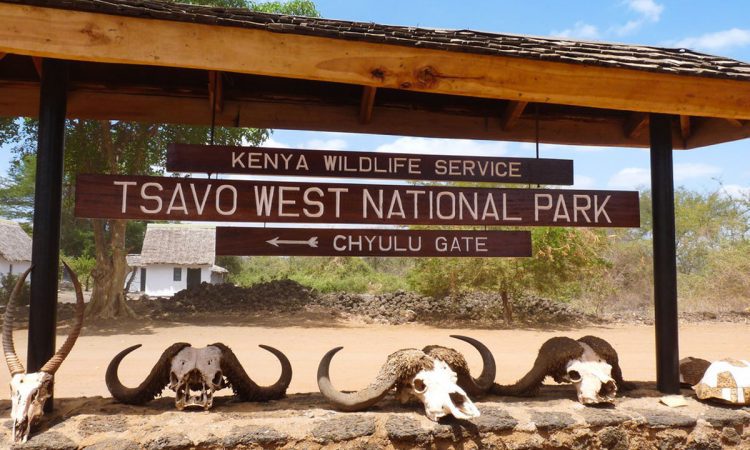
Tsavo West is 9,065 square kilometres of volcanic terrain, green hills, spring-fed oases, and savanna that looks nothing like the Masai Mara. It is Kenya’s second-largest protected area. It has the Big Five. It has park fees substantially lower than the Mara. And it has a set of geological and ecological features that exist nowhere else in the country, most of which the average safari visitor drives past without knowing they are there.
Mzima Springs
Four natural springs producing roughly 220 million litres of crystal-clear water daily. The source is rainfall on the Chyulu Hills, a volcanic range whose porous lava rock absorbs water and filters it underground for decades before it resurfaces here. The water emerges from beneath parched lava into pools and rapids that run approximately two kilometres before disappearing underground again into another lava flow.
The springs support a resident population of hippos and Nile crocodiles that are visible in the clear water in a way that is impossible at any muddy river crossing. An underwater observation hide allows you to watch hippos from below the surface, one of the only places in Kenya where this is possible. Birdlife around the springs is dense, with kingfishers, herons, and African fish eagles working the pools.
Most safari vehicles stop at Mzima for 20 to 30 minutes. That is not enough. Bring binoculars. Walk the boardwalk slowly. Watch the crocodiles on the far bank. If your guide is willing, spend an hour here in the early morning before other vehicles arrive. The silence, broken only by water and birdsong in the middle of an otherwise arid park, is the point.
Shetani Lava Flow
Four kilometres west of the Chyulu Gate, the road crosses a field of black volcanic rock that stretches roughly 50 square kilometres across the savanna. This is the Shetani Lava Flow, formed approximately 200 years ago during the last volcanic eruption in the area. “Shetani” means “devil” in Kiswahili. Local Kamba communities who witnessed the eruption believed the molten rock was the devil emerging from the earth. The name stuck.
The lava field is jagged, black, and almost entirely barren. Virtually no soil has formed on it in two centuries. The contrast with the green savanna surrounding it is stark enough to feel unreal, as if someone dropped a piece of Iceland into southern Kenya. At sunset, the black rock absorbs the warm light and the Chyulu Hills behind it turn purple. It is one of the most photogenic locations in any Kenyan national park and one of the least photographed.
The Shetani Caves, adjacent to the lava flow, are accessible on foot and worth exploring with a guide. They are lava tubes formed during the eruption, cool and dark inside, with rough walls that show the flow patterns of molten rock. Bring a torch.
Chyulu Hills
The volcanic range that feeds Mzima Springs rises to the northwest of Tsavo West and is accessible from within the park or from the separate Chyulu Hills National Park. The hills are young by geological standards, some formations are only 500 years old, making them among the youngest volcanic features in Kenya.
From the upper slopes, on a clear day, you can see Mount Kilimanjaro to the south. The hiking is excellent and almost entirely unvisited. The vegetation shifts from savanna grassland at the base to montane forest and open moorland at higher elevations. The hills also contain one of the longest known lava tubes in Africa, Leviathan Cave, stretching over 11 kilometres underground. Access to the cave requires permission and a guide, but it is open to visitors.
The Chyulu Hills are where the water cycle that sustains Mzima Springs begins. Standing on the ridge and looking south toward the springs 50 kilometres away, knowing that the rain falling on your boots will take a quarter century to reach that hippo pool, is the kind of long-view thinking that a safari in the Mara never requires.
Ngulia Rhino Sanctuary
A fenced sanctuary within Tsavo West dedicated to the recovery of the critically endangered eastern black rhino. The sanctuary was established in 1986 when poaching had reduced Tsavo’s rhino population from an estimated 8,000 in the 1970s to fewer than 100. The population within the sanctuary has since recovered to several dozen animals under intensive KWS protection.
Game drives through the sanctuary offer one of the better chances of a black rhino sighting in Kenya outside of Ol Pejeta and the Mara Triangle. The terrain inside the sanctuary is dense bush, which means sightings require patience and a good guide. Early morning drives are most productive.
Ngulia is also famous among ornithologists for its bird ringing station, which has operated since the 1960s. During the October to November migration season, hundreds of thousands of Palearctic migrant birds pass over the Ngulia hills on their way south. On misty nights, the birds are attracted to the lights of Ngulia Safari Lodge, and researchers ring and record thousands of individuals. It is one of the most important bird migration monitoring sites in East Africa.
Lake Jipe
On the Kenya-Tanzania border at the southern edge of Tsavo West, Lake Jipe is a shallow, seasonal lake fed by the Lumi River descending from Mount Kilimanjaro. The lake is a birdwatcher’s destination of the first order, with species including the African swamp hen, Madagascar squacco heron, black heron, and palm-nut vulture among the recorded residents and visitors.
Boat trips on Lake Jipe are possible and put you on the water with hippos, crocodiles, and a backdrop of the Pare Mountains in Tanzania. The lake is remote within the park and receives very few visitors. Access is via the Jipe Gate on the southern boundary. The road from the main Tsavo West circuit to Jipe is long and rough, which is precisely why it stays empty.
Roaring Rocks and Poacher’s Lookout
A rocky outcrop on the western escarpment of Tsavo West that provides a panoramic view across the park’s entire developed area. The name “Roaring Rocks” comes from the sound the wind makes as it passes through the rock formations. On a clear day, the view stretches to the Chyulu Hills in the north and across the savanna to the south.
Poacher’s Lookout, nearby, was historically used by ivory poachers to spot wildlife and by rangers to spot poachers. Today it is a game-viewing point where you can sit above the landscape and watch elephant herds move through the valleys below. It is one of the few places in any Kenyan park where the view itself is the primary attraction, not a supplement to a game drive.
The World War One Battlefields
Tsavo West contains some of the last remaining physical traces of the East African Campaign of World War One. The park’s rugged terrain was the site of engagements between British and German colonial forces. Remnants of trenches, camps, and supply routes are scattered through the bush, largely unmarked and unvisited. Your guide may know where some are. Most tourists do not ask.
The historical layer adds something to Tsavo that pure wildlife parks cannot offer: a sense that this landscape has been contested, lived in, and shaped by human events that the savanna has mostly swallowed.
The Man-Eaters
No article about Tsavo is complete without them. In 1898, two male lions killed an estimated 28 to 135 workers (the exact number is disputed, recent chemical analysis of the lions’ bones published in 2009 by researchers at the Field Museum of Natural History in Chicago estimated 35 victims) during the construction of the Kenya-Uganda Railway bridge over the Tsavo River. The lions were eventually shot by Lieutenant Colonel John Henry Patterson. Their preserved skins and skulls are displayed at the Field Museum in Chicago.
The man-eaters are the reason most people have heard of Tsavo. The irony is that the park’s current lion population, while less famous, is one of the most interesting in Kenya. Tsavo’s male lions are frequently maneless or have significantly reduced manes compared to Mara lions, likely an adaptation to the hotter, drier climate. Spotting a maneless Tsavo male in the bush, knowing the history of this specific landscape, adds a charge to the sighting that a Mara lion, however photogenic, does not carry.
Where to Stay
Kilaguni Serena Safari Lodge: the first lodge ever built inside a Kenyan national park (1962). Overlooks a waterhole. Fifty-two rooms. Rates from USD 150 to USD 300 per person full board. The old-school safari atmosphere here is genuine and unreplicable.
Finch Hattons Luxury Camp: the high-end option. Tented suites on the banks of a hippo pool. If your budget allows, this is among the most atmospheric luxury camps in southern Kenya.
Ngulia Safari Lodge: positioned on the edge of the Ngulia escarpment with views across the valley. Famous for the bird ringing station. Mid-range pricing.
Severin Safari Camp: tented camp near Mzima Springs. Solid mid-range option with good guiding.
KWS public campsites and bandas are available for self-drive budget travelers. Rates are minimal. Facilities are basic.
Getting There
Mtito Andei Gate: the main entry point, located directly on the Nairobi-Mombasa highway. 230 km from Nairobi, roughly three hours by road. The SGR Madaraka Express stops at Mtito Andei on the inter-county service (8:00 AM departure from Nairobi).
Chyulu Gate: accessed from the Nairobi-Mombasa highway via Kibwezi. Best entry point for the Shetani Lava Flow and Chyulu Hills.
Tsavo Gate: connects Tsavo West to Tsavo East via the Tsavo River bridge.
Jipe Gate: southern boundary, for Lake Jipe access.
Park Fees
KWS fees for Tsavo West are lower than the Masai Mara. Non-resident adults: USD 52 per day (confirm current rates on kws.go.ke). Kenyan citizens: KES 515. East African residents: KES 1,030. Vehicle fees apply separately. The lower fee structure is one of Tsavo West’s clearest budget advantages over the Mara.
When to Visit
June to October (dry season) for the best game viewing, particularly around waterholes and the springs. January to February is also dry and less crowded. The long rains (April to May) make some roads impassable and reduce visibility, but the park is green and birdlife peaks.
Why Most People Miss It
Tsavo West does not have the Great Migration. It does not have the predator density of the Mara. It does not have a single iconic image that sells on a poster. What it has is geological drama, ecological complexity, historical depth, and the kind of solitude that the busier parks cannot structurally provide. A two-night stay in Tsavo West, combined with Amboseli or the coast, adds a dimension to a Kenya itinerary that the Mara alone cannot deliver.
The springs that take 25 years to arrive. The lava field that locals named after the devil. The rhino sanctuary rebuilt from near-extinction. The lion with no mane. Tsavo West is not a park that announces itself. It rewards the traveler who shows up with patience and stays long enough to look.